From Law To Activewear: How Harshita Motaparthi Co-Created Mile Collective with Samantha Ruth Prabhu

Harshita with her husband and co-founder, Pravishta Nadella.
How did the idea of Mile Collective come about?
I always had a very strong desire to build something of my own. Even as a law school student, I couldn't shake the feeling that I was meant to do something else. I don't have any kind of fashion or business background so the idea for Mile Collective (initially Mile Active) came about naturally and from a very personal pain point. I had been working out for a long time, and whenever I wanted good-quality activewear, I could only buy it while I was travelling or if I asked someone visiting India from abroad to bring it for me. I began speaking to others who were in the same boat; initially the conversations were casual, but eventually they became intentional. I realised I wasn't alone — many women had the same problem as me.
At that point, there were barely any activewear brands in India. Women were increasingly turning to fitness and wellness, especially after COVID, but there just wasn't enough good-quality clothing to support that shift. That's how the journey of the brand began. Because I was new to both fashion and business, I wanted to start small and test the product. I launched the brand as Mile Active in 2023 and ran it for a little over a year. Looking back, I see that period as my pilot project. I spent so much of my time then talking to our customers and community on Instagram — learning what they liked, what they didn't, and what they wanted but weren't able to get from an activewear brand in India. We were so excited with the response that we received. This was also when my husband, Pravishta, came on board as my co-founder. We took a little break and spent that time overhauling our branding and getting comfortable with our vision for the brand. We soon realized that there was a distance between where we were then and where we wanted to be, and we knew that our next step had to be finding an investor who could support us in that journey. We wanted to build big, and we needed a partner to build it with.
Samantha Ruth Prabhu was the first name that came to mind. Our visions aligned, but there was one thing we had to make room for: she wanted to come on board as both an investor and a co-founder. Fitness and wellness have been part of her public life for a long time, and a brand like ours was a natural extension of something that is important to her. Even beyond the reach and money, Pravishta and I both saw that she could bring something that was perhaps most important to a brand like ours: the perspective of someone who had made fitness a part of her life for years. And so Mile Active became Mile Collective, and we launched in January 2026.
What does being a purpose-led brand mean for Mile Collective? Where does that purpose appear beyond brand messaging and marketing collateral?
Being purpose-led is very important to us. Whenever we’re making a decision about product or marketing, we return to why we started in the first place. For us, that means making everyday dressing effortless for women. That is the central idea we keep returning to and the purpose we’re building around. When you think of activewear, you imagine women who are deeply focused on fitness. But our customer has more range than that. She isn’t only someone who regularly runs races or goes to the gym, she is also someone who is just beginning her fitness journey or experimenting with different forms of movement.
Activewear in India has moved from something worn purely for workouts to something at the intersection of fashion, wellness and identity. As both a founder and a customer, what do you think has driven that shift?
Two things. Social media has certainly played a role. We see how people both in the West and at home in India — whether influencers, celebrities or friends whose style we admire — are dressing, and we want a piece of that for ourselves. The bigger shift, however, is that fitness is now much more integrated into everyday life. Earlier, someone might have worked out over the weekend when they found the time. Today, people build movement into their daily routines. Women may work out in the morning, grab a coffee, run errands and then go to work. People’s lives are also busier, so activewear, athleisure, fitness and wellness have begun to operate as a broader category than what it did before. The variety of movement people now participate in throughout the day has contributed to that shift too.
There is a very community-first perspective that is shaping how fitness and wellness are seen right now. Do you think that helps bring more women into it?
Definitely. Compared with earlier, you can now see friends, siblings and family members booking workout classes and attending them together. That wasn’t as common before. There is a reason why run clubs have grown so quickly in India. Running used to feel intimidating; if you couldn’t run a 5K or 10K, you may not have considered yourself a runner before. Now, it's different. In a run club, you can begin alongside someone else who is also starting out or with someone who has been running for a long time. There is also the social aspect to communities like these — activities like meeting new people and geting coffee together afterwards is very much part of it. The community element makes fitness feel more welcoming and less intimidating to women.

What do Indian women demand from activewear that a global brand may not understand and that a homegrown brand is better placed to execute?
There are key differences in both product and marketing that I believe homegrown brands understand better about the Indian consumer. In international campaigns, Indian women may not always feel visually represented. This, I believe, is key: we want to see ourselves in the clothes.
Product is even more important. Activewear fits very differently from regular clothing, and Indian women’s bodies differ from the bodies many Western brands design around, which is something that I believe that no one understands better than a founder who is Indian herself. Climate and silhouettes matters too; most parts of India are hot and humid for much of the year. We initially launched several fitted garments. Once we started speaking to customers, however, we learned that although they loved these products, they also wanted more relaxed options. When it is very hot, they don’t always want to wear something fitted. Another cultural consideration is that many women aren’t comfortable wearing only leggings or shorts with a sports bra, they want a top to cover up. An international brand might focus more heavily on sports bras because that's what their target customer asks for.
At what point does it make sense to bring a celebrity investor or co-founder on-board with a significant degree of influence and reach?
It depends on the business and how quickly it wants to scale. I felt comfortable and confident because we already had a product that had worked for around a year and a half. We had collected customer feedback, understood what was and wasn’t working and made changes accordingly. That data and experience gave me the confidence to say, “We have a product that works; now let’s scale it.” Many companies launch with a celebrity from day one, but their plans and trajectories are different. For me, having what I call the pilot phase was extremely helpful. All of our marketing comes from a place of confidence because we know the product works.
Does the visibility that comes with a celebrity co-founder make the journey easier?
It does make it easier in many ways. I have seen the brand as Mile Active, when it was just me, and now as Mile Collective, with Samantha. There is a significant difference. She brings visibility, but she also helps inculcate a strong sense of trust in the brand, especially when someone shops with us for the first time.
Conversations around Indian activewear often point out that brand imagery isn’t diverse enough to represent the full breadth of Indian women who participate in fitness. How is Mile Collective changing that, or how will it in the future?
To be honest, we aren’t consciously changing that yet because we’re still a very small brand and have only recently entered this phase. Our present size range isn’t as inclusive as we want it to be. We currently offer four sizes, and we don’t intend to stop there.
For us, expanding inclusivity isn’t only about adding XL or XXL, we also want to offer different lengths because Indian women vary greatly in height. We want to build the system that allows us cater to everyone. From a business perspective, however, that requires significant supply-chain involvement. That is the main reason we aren’t yet as inclusive as we would like to be. When we reach the point where we can expand the range properly, the way we communicate and market the product — and our visual language — will naturally evolve too. It is a priority, but I want to be transparent that it remains a work in progress for now.
What has the Indian customer taught you that you may not have learned from a conventional sizing chart or international standard?
Beyond fit and fabric, colour has taught us a lot as well. We’ve experimented with it extensively. When we launched our leggings, which are our hero product, we assumed colours such as black, navy and other muted shades would perform best. Black did very well, but Grape Jelly surprised us. It is quite bright and not muted at all. We introduced it as an experiment, thinking some customers might not like it, but it became one of our fastest-moving colours. Whenever it would sell out, we would get messages from customers asking for restocks. The excitement around it was unexpected, but it was a very welcome surprise. We quickly realized that Indian women are ready to experiment and have fun with both colours and silhouettes, so we’re now moving further in that direction.
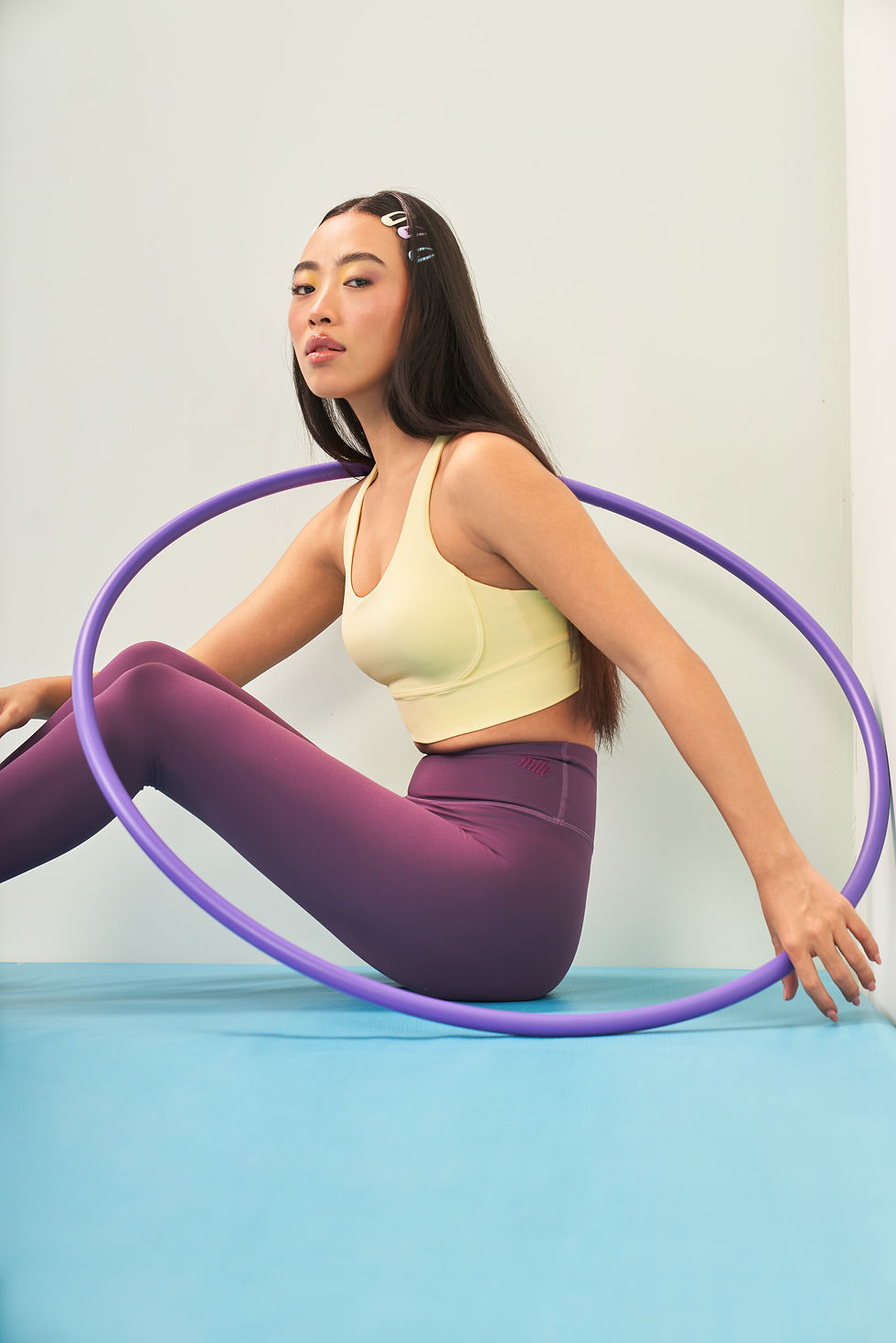
What do you want a woman to feel when she wears Mile Collective for the first time, something that may have nothing to do with how her body looks?
Confidence. A customer recently tagged us in a post on Instagram: she had purchased a pair of shorts from us and wrote about how she wasn’t allowed to wear shorts while growing up. She had always stayed away from them and internalized the idea that she could never wear them. Inspite of it all, she decided to try a pair from us, and her post described how confident and cool they made her feel. Seeing that reminded us that what ultimately matters is how women feel when they wear Mile. That is the feeling we want to continue building on.

Where do you think women’s fitness culture in India is headed over the next five years? What will that mean for the activewear industry and newer homegrown brands like Mile Collective?
I think we’re just getting started. I’ve been working out for a long time and strength training has always been a core part of my workouts. A few years ago when I told friends or family I was going to the gym to lift weights, the first response was often, “You’ll become bulky and look like a man" or "Maybe you shouldn’t lift”. Now, people are much better informed and far more open to different forms of exercise. They understand the importance of health and wellness in general. There has been a significant mindset shift.
You can see it in events such as the Tata Mumbai Marathon and HYROX, where women’s participation increases year after year. Women are getting out there and finding whatever form of movement works for them. That will naturally support the activewear industry because women want clothing that supports them through these activities. We’re going to see more homegrown brands and much more growth in this space, which is ultimately good for everyone.
If Mile Collective succeeds exactly as you envision, what do you hope it will have changed — not only commercially, but in the culture around women, fitness, movement and wellness?
I hope women feel that movement doesn’t have to be intimidating or complicated. I keep returning to community because I believe it plays a major role. I hope we contribute to a culture in which women don’t exercise only because they feel they need to lose weight, but because movement is fun, they genuinely enjoy it and it becomes part of their lives. That is how I view movement. Growing up, whenever I entered a store, I noticed that around ninety per cent of it — whether shoes or apparel — was dedicated to men. Even when I was very young, I questioned this. It is changing now, of course and I believe homegrown brands like ours have played a huge role in that shift, but that was the reality in India for a long time.
We want to be a small part of a woman’s journey from the moment she starts. If someone wants to run her first kilometre, we want to be there to support her. If someone is preparing to run her first marathon, we want to be there too. Movement shouldn’t be intimidating or complicated; it should be fun. We want to accompany women on that journey.
Discover Mile Collective on MileCollective.com

Comments